Mark
Mark is the shortest and the swiftest of the four Gospels.
About Mark
Mark is the shortest and the swiftest of the four Gospels. Its narrative drives forward with breathless urgency — the word “immediately” (Greek euthus) appears more than forty times — and lays before us the unforgettable image of Christ as the Servant of the Lord, doing the will of the Father from the wilderness of the Jordan to the wood of the cross.
The earliest patristic tradition is unanimous about Mark's authorship. Papias of Hierapolis (ca. AD 130), preserved by Eusebius, transmits a tradition that comes “from the elder John”: “Mark, having become Peter's interpreter, wrote down accurately, but not in order, the things either spoken or done by Christ.” Saint Justin Martyr quotes Mark as “the memoirs of Peter,” and Saint Irenaeus places the composition shortly after Peter's martyrdom in Rome. The author is the John Mark of Acts (Acts 12:12, 12:25, 15:37) and the “son” Peter calls his own in his first epistle (1 Pet. 5:13). The Gospel was almost certainly composed in Rome between AD 60 and 70, for a Gentile audience already suffering persecution under Nero.
The themes of Mark are servanthood, the cross, and the cost of discipleship. Mark presents Christ not first as teacher (as Matthew does) or as Savior of the lost (as Luke does), but as the suffering Son of Man who “came not to be ministered unto, but to minister, and to give his life a redemption for many” (10:45). The first half of the Gospel rises to Peter's confession at Caesarea Philippi (8:29); the second half descends to Calvary. The Roman centurion's confession at the foot of the cross — “Indeed this man was the son of God” (15:39) — closes the great arc that the heavenly voice opened at the baptism (1:11).
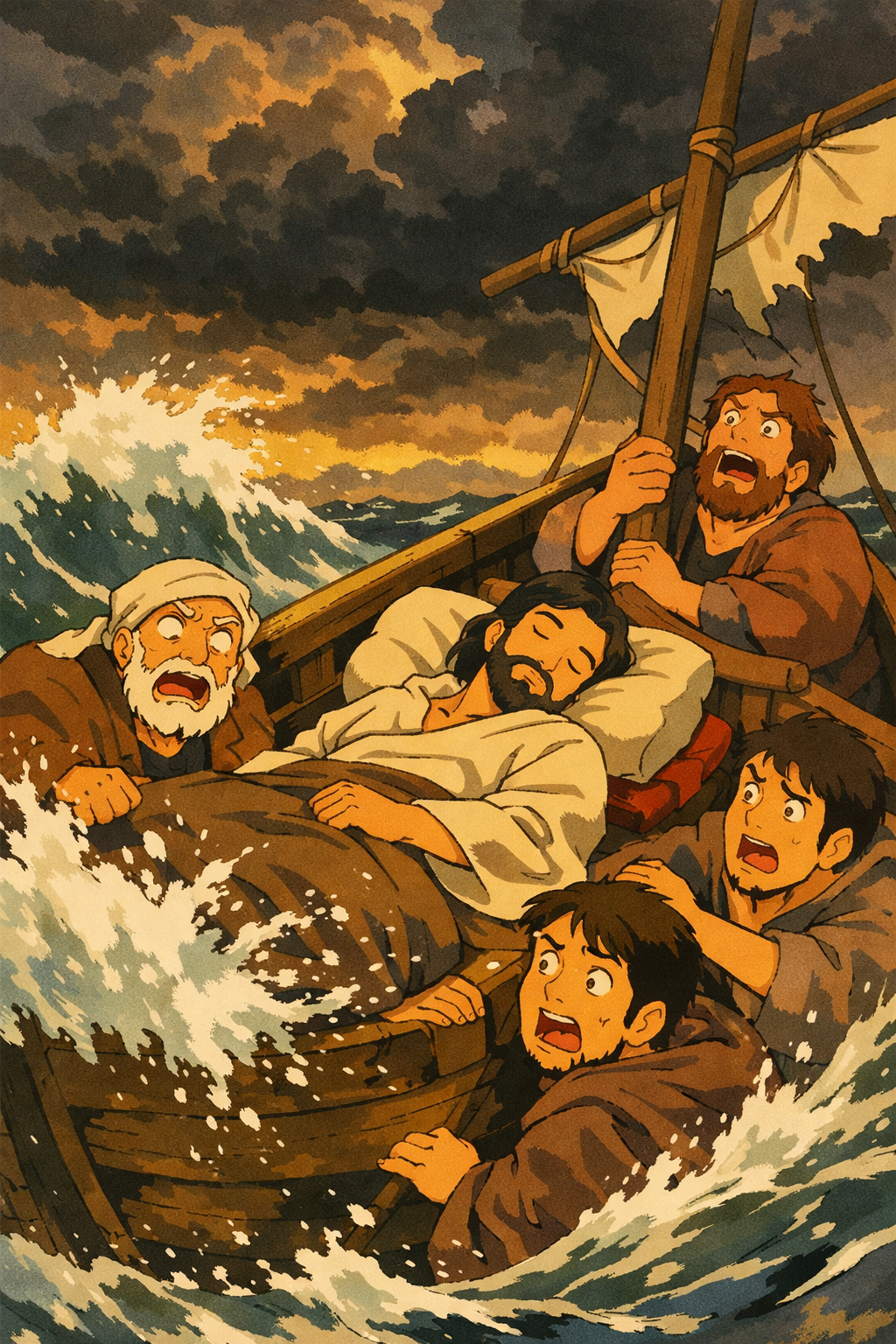
Literarily, Mark is the Gospel of action. He records few of Christ's discourses but reports many of his deeds: exorcisms, healings, calmings of the sea, miraculous feedings. His narrative is studded with vivid eyewitness detail (the green grass on which the five thousand sat, the cushion in the boat during the storm, the look Jesus gave the rich young man and “losed him”) — touches that the Fathers attributed to Peter's own remembrance. The so-called “messianic secret” — Christ's repeated commands to silence — runs through Mark, building dramatic tension that breaks open only at the cross.
In Catholic life, Mark is the Gospel of Year B in the Sunday lectionary, read on most Ordinary Time Sundays of that year. The Catechism cites Mark on the kingdom (CCC 567), the call of the Twelve (CCC 858), the institution of the Eucharist (CCC 1339), and the Great Commission (CCC 1223). The Gospel ends in the longer ending (16:9–20) with the resurrected Christ commanding his apostles, “Go ye into the whole world, and preach the gospel to every creature” — the missionary mandate that would carry Peter to Rome and the Gospel of his interpreter to every nation under heaven.
Key verse
“For the Son of man also is not come to be ministered unto, but to minister, and to give his life a redemption for many.”
— Mark 10:45
Notable chapters in Mark
- Mark 1
The Baptist, the baptism, and the wilderness
Mark opens without infancy narrative — “The beginning of the gospel of Jesus Christ.” John baptizes; the heavens open; the Spirit drives Christ into the desert.
- Mark 4
The parable of the sower and the storm
Christ teaches the kingdom in parables; that night, on the sea, he calms the storm with a word: “Peace, be still.”
- Mark 5
The Gerasene demoniac, Jairus’s daughter, the woman with the issue of blood
Three miracles in a single chapter — the demoniac restored, the bleeding woman healed, the dead girl raised. “Talitha cumi.”
- Mark 8
Peter’s confession at Caesarea Philippi
The midpoint of the Gospel. “Whom do men say that I am?” Peter answers: “Thou art the Christ.” From here, the road turns toward Jerusalem.
- Mark 10
On marriage, children, and the rich young man
“What therefore God hath joined together, let no man put asunder.” “Suffer the little children to come unto me.” “Go, sell whatsoever thou hast.”
- Mark 14
The anointing at Bethany and the Last Supper
“Take ye: this is my body… this is my blood of the new testament.” Christ institutes the Eucharist; Gethsemane follows.
- Mark 15
The Crucifixion
The centurion’s confession at the foot of the cross: “Indeed this man was the son of God.” The first Gentile to confess Christ.
- Mark 16
The Resurrection and the Great Commission
The empty tomb, the women, the angel. The longer ending: “Go ye into the whole world, and preach the gospel to every creature.”
Read Mark the way it was meant to be read.
Story Mode, illuminated chapter art, and audio narration in seven languages — free on iOS.
Read Mark in Sacred Scrolls