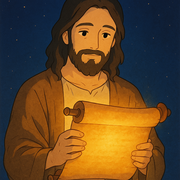
Matthew
The Gospel of Matthew stands at the threshold of the New Testament — the bridge between the Old and the New, the Gospel that takes the most pains to show that Jesus of Nazareth is the Christ promised in the law and the prophets.

About Matthew
The Gospel of Matthew stands at the threshold of the New Testament — the bridge between the Old and the New, the Gospel that takes the most pains to show that Jesus of Nazareth is the Christ promised in the law and the prophets. Saint Augustine called Matthew the most fitting of the four Gospels to open the Christian Bible, because no other shows so clearly that the same God who spoke through Moses and Isaiah is now speaking through the Son.
From the earliest patristic witness — Papias of Hierapolis (ca. AD 130), Irenaeus, and Origen — Catholic tradition has identified the author as Saint Matthew, the tax collector called from his customs booth (Matt. 9:9), one of the Twelve. Papias reports that Matthew composed his Gospel “in the Hebrew dialect” — most likely Aramaic — and that others later translated it. The Greek text we now possess is either Matthew's own later edition or a faithful translation by an inspired hand. The Pontifical Biblical Commission's 1911 reply on Matthew affirmed Matthean authorship and a date in the apostolic age, with most Catholic scholars placing the final Greek form between AD 50 and 70.
The themes of Matthew are kingship, fulfillment, and discipleship. The book opens with a genealogy that traces Jesus' royal line from Abraham through David — establishing him as the heir of the covenants. Throughout, Matthew quotes the Old Testament more often than any other evangelist (some 130 times by careful count), driving home the refrain: “That it might be fulfilled what was spoken by the Lord through the prophet.” Christ is the new Moses on the new mountain (the Sermon on the Mount, chs. 5–7), the Son of David enthroned by the Father, the Emmanuel of Isaiah's prophecy who will be with his Church always (28:20).
Literarily, Matthew is structured around five great discourses, each closing with the formula “when Jesus had ended these words.” The Sermon on the Mount (chs. 5–7), the Mission Discourse (10), the Parables of the Kingdom (13), the Discourse on the Church (18), and the Eschatological Discourse (24–25) form a deliberate Pentateuch — five books of the new Moses. Surrounding these discourses, the narrative unfolds Christ's birth, ministry, passion, resurrection, and the Great Commission to baptize all nations “in the name of the Father, and of the Son, and of the Holy Ghost” (28:19).
In Catholic life, Matthew has shaped the Church's prayer and teaching at every level. The Sermon on the Mount, with the Beatitudes (5:3–12), the Our Father (6:9–13), and the Golden Rule (7:12), is the moral charter of the Christian life — the Catechism devotes the entire fourth part to the Our Father (CCC 2759–2865). The promise to Peter — “Thou art Peter, and upon this rock I will build my Church” (16:18) — is the foundation of the Petrine ministry. The institution of the Eucharist (26:26–28), the burial and resurrection accounts, and the Great Commission close the Gospel with the certainty that Christ is, indeed, Emmanuel — God with us, until the consummation of the world.
Key verse
“Going therefore, teach ye all nations; baptizing them in the name of the Father, and of the Son, and of the Holy Ghost. Teaching them to observe all things whatsoever I have commanded you: and behold I am with you all days, even to the consummation of the world.”
— Matthew 28:19-20
Notable chapters in Matthew
- Matthew 1
The genealogy and birth of Jesus
The royal line from Abraham through David to Joseph, husband of Mary; the angel’s annunciation to Joseph; “they shall call his name Emmanuel.”
- Matthew 5
The Beatitudes and the Sermon on the Mount
“Blessed are the poor in spirit…” The new Moses on the new mountain inaugurates the kingdom’s charter.
- Matthew 6
The Our Father and treasure in heaven
“Thus therefore shall you pray” — the Lord’s Prayer is given. “Seek ye therefore first the kingdom of God, and his justice.”
- Matthew 13
The parables of the kingdom
The sower, the wheat and the tares, the mustard seed, the hidden treasure, the pearl of great price — seven kingdom parables in a single discourse.
- Matthew 16
Peter’s confession and the keys
“Thou art the Christ, the Son of the living God… thou art Peter, and upon this rock I will build my Church.”
- Matthew 25
The wise virgins and the last judgment
“As long as you did it to one of these my least brethren, you did it to me.” Christ’s parable of the sheep and the goats.
- Matthew 26
The Last Supper and Gethsemane
“This is my body… this is my blood of the new testament.” The institution of the Eucharist, the agony, the betrayal.
- Matthew 28
The Resurrection and the Great Commission
“Going therefore, teach ye all nations… baptizing them in the name of the Father, and of the Son, and of the Holy Ghost.”
Read Matthew the way it was meant to be read.
Story Mode, illuminated chapter art, and audio narration in seven languages — free on iOS.
Read Matthew in Sacred Scrolls